
Wooden board creaking, door suddenly slamming, purple shadows, a funky smell, a metal aftertaste. How would you describe a haunted manor?
A ghostly presence is fragmented, often something that tells you it is there, without actually showing up. Even the figurative form of a ghost is portrayed as something incomplete: a blurry, pale silhouette, or a decomposing corpse. Skeptics may say they are just an interaction of man-made things with naturally occurring phenomena: a leak in your basement due to a heavy storm forms a creepy, half-lit little pool and a disturbing dripping sound. Or, in other words, a ghost is born.
But the dictionary (a believer) says:
ghost | ɡōst |
noun
an apparition of a dead person which is believed to appear or become manifest to the living, typically as a nebulous image: the building is haunted by the ghost of a monk | [as modifier] : a ghost ship | the ghosts of past deeds figurative.
A dead being manifested to the living typically as a nebulous image. What if this “nebulous image” is not of a dead person, but of something that was never alive to begin with and yet, somehow, we perceive it as a presence? These could be called “artificial ghosts”, and, opposing their “natural” (heck, “organic”?) counterparts, they are not a matter of believing or not.
All this pretentious, half-baked terminology talk may sound dull, so for hypothetical purposes and some peace of mind, let’s go back to a haunted manor story. Once upon a time, in this manor dwelled two artificial ghosts: the first haunted not men, but tigers and lions; the second one, more traditionally, begins with death. Again, both of them are very much real.
The first ghost: big cats love Calvin Klein’s Obsession for Men cologne
Lions, tigers, leopards, and other big cats have a particular thing for Calvin Klein’s Obsession for Men cologne. Just a hint of the fragrance over a surface is enough to make these animals mysteriously intrigued by it for quite a while.
In the wild, field biologists in Central America spray the cologne Obsession for Men on trees and rocks to draw jaguars into camera traps. In Nicaragua and Guatemala, this technique has allowed scientists to capture rare images of elusive predators, sometimes even encouraging the cats to rub, roll, and drool, as if under a trance. Others would look at a piece of stone with hungry eyes and raised backs.
But why this specific fragrance? Researchers at the Bronx Zoo tested over 20 different perfumes to see which ones kept big cats most engaged. Obsession for Men won by far, holding a tiger’s attention for up to 11 minutes, compared to just seconds for other scents. The secret seems to lie in civetone, a musk-like compound used in the perfume. One theory is that civetone mimics pheromones found in the glands of the African civet, an animal sometimes hunted and preyed upon by large felines.
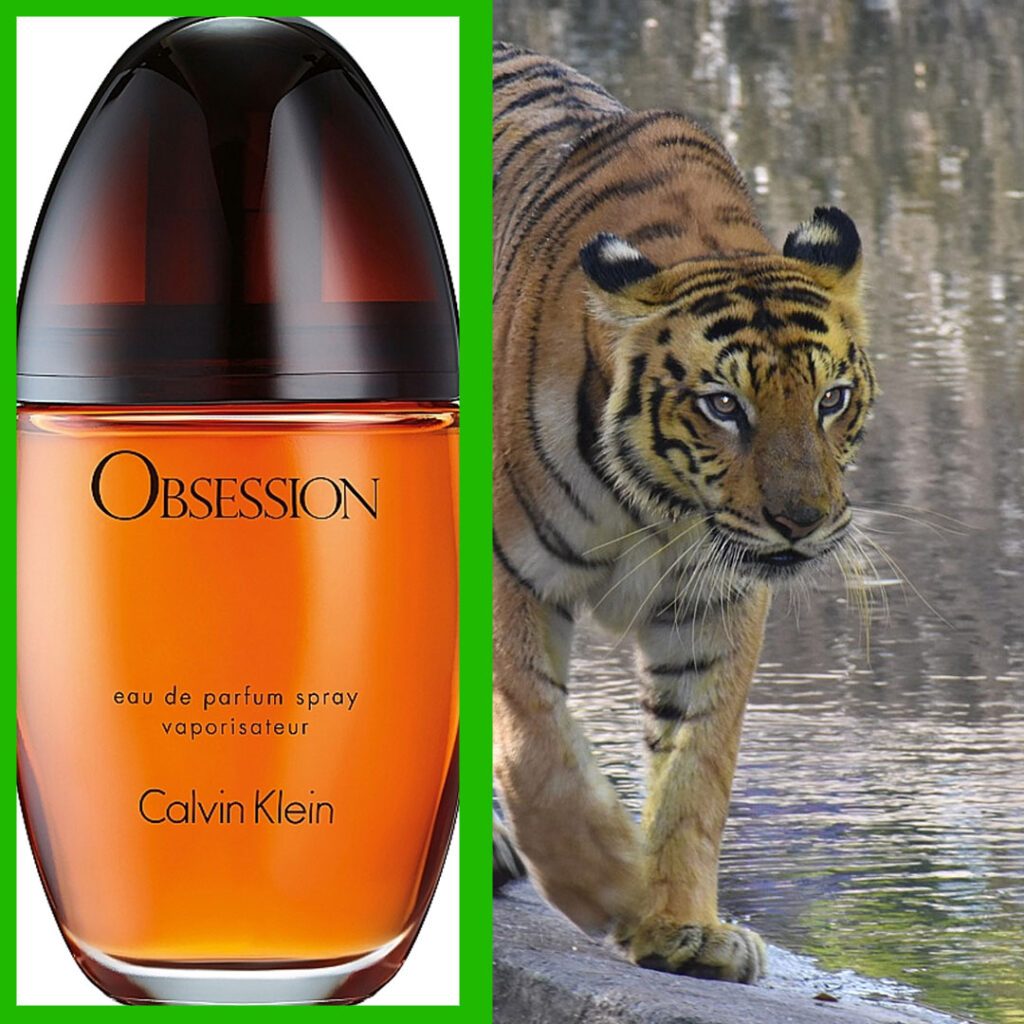
If so, to big cat eyes, this mysterious yet somehow familiar prey either hides too well, runs too fast, or turns its flesh into tooth-wrecking pieces of wood and stone. Only one part of it is clear as day: its scent. Irresistible. And that is enough to manifest an animal that never was. An artificial medium so well crafted to these animals – even if unintentionally – that almost has a pulse.
And so big cats remind us that unplaced presences are not by definition scary, their spookiness has more to do with the way a particular person experiences them. But they are always fascinating. That is one of their most ontological features: a ghost haunts (in the sense that dwells in a physical place), and sometimes it spooks, but most importantly, it lures – and not only humans.
The second ghost: pictures
“The photograph is literally an emanation of the referent. From a real body, which was there, proceed radiations which ultimately touch me, who am here; the duration of the transmission is insignificant; the photograph of the missing being will touch me like the delayed rays of a star.”
Barthes, Roland. 1981. Camera Lucida: Reflections on Photography. Translated by Richard Howard. New York: Hill and Wang.
Barthes wrote his ideas about photography while suffering from grief. His mother had just died, that is when photographs became eerie. She was still there, in the living room, inside pieces of paper walled by elegant frames, but she was also dead. If he ended up later describing the presence of an image as “delayed rays of a star”, one can imagine that his first realization about it felt more like the chilling reach of a ghost.
He imagined photography as a presence moving across time and space — a physical trace of someone that once stood before the lens, now transmitted to the present viewer like a phantom touch or a warm sunny day – depending on one’s disposition. Barthes’ ideas, serving like a bridge to another realm, shed light on another type of artificial ghost. One that holds a lot of power over us: the ghost of imagery, especially photographs.
Why are they so artificial, if what we see is a recorded piece of our world and people? Because if the stone appears to be a delicious meal for the tiger, it does not mean that it once had a beating heart. In a way, the optic mechanism that makes photographs possible is just like the chemical component that lures tigers: an artificial process interacting with an ecosystem. Just as a tiger rolls ecstatically in the chemical aura of civetone, humans circle endlessly around our recorded likeness, mesmerized not by the object itself but by the haunting, unique qualities of imagery. And what sets recorded images apart from other experiences one might have (you can, after all be fooled by a familiar scent just like a tiger) is our ability to relate so deeply with these images, which feel like a part of us and the world we live in. Basically, it is self-awareness which fuels our images with a type of knowledge that surpasses even the most subtextual aspects of content and form.
‘These technological or chemical signals bypass rational thought, evoking a primordial response: instinct and, in the case of humans, self-awareness.’
There is no need to say that we are surrounded day and night by photos and videos. No need also to enter the saturated discourse about screens and social media either – please don’t think of Black Mirror when reading this. The point is that, maybe, you feel an unaccounted presence in your house right now. You may have a constant, disturbing feeling that you are never alone; and no matter how many times you check doorlocks and closets, this feeling just won’t go away. And if it is not news for you that hyper connectivity is the cause, it might help, from a psychological perspective, to transform this abstract concept into a being – a character, a story. Doing that, we turn intimate a subject that is often tackled in an impersonal way, full of abstractions and nominalizations: how image-based media transforms our sense of awareness and presence.
There are, after all, benefits about believing in ghosts. Through their making we can grasp more vividly how media can become very much alive (or undead) in our lives.
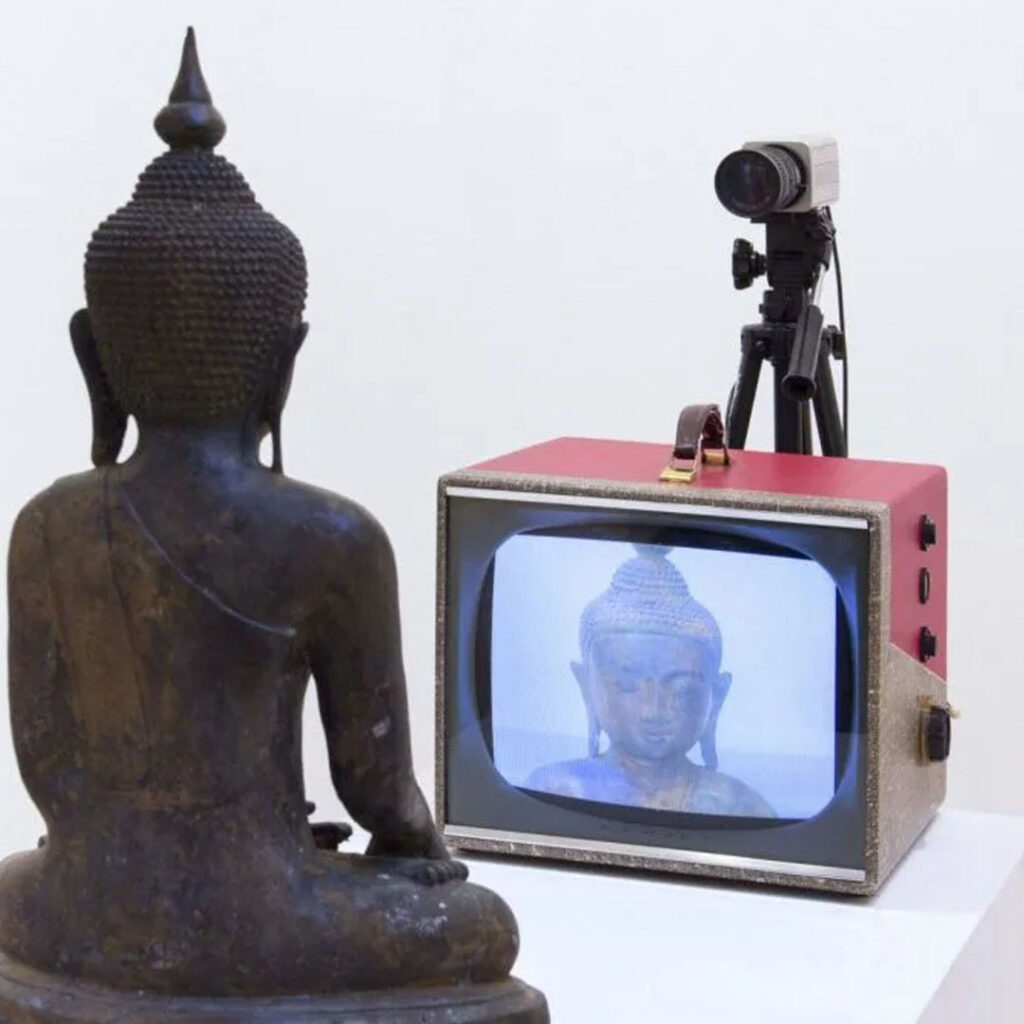
TV Buddha by Nam June Paik (1974)
A statue of the Buddha, a symbol of self-awareness and detachment, faces a live video feed of itself: an endless loop of self-reflection. The statue is drawn to its own image as if mesmerized by an invisible force. That is “TV Buddha”, an artwork by Korean artist Nam June Paik. Paik has done many works concerning the subject of screen feeds; and long before the word, “feed”, became an endless virtual space where millions spend most of their days.
TV Buddha was first exhibited in New York City in 1974. The work has been reproduced in many places ever since, adding even more layers to its message.
One of them is the Tate Modern, which displayed many other “television sculptures” by Paik in addition to TV Buddha. The museum also relies heavily on surveillance cameras to guarantee the “well-being” of its displays and archives. I wonder, what the staff of Tate’s multimillion-dollar surveillance operation thought while they watched, day after day, a statue of Buddha watching, day after day, a live feed of itself. Do they ever relate with it? And if a CCTV feed ever jitters a bit due to bad connection or a little cleansing rub, do Tate’s artworks ever feel alive in the eyes of their subcontracted guardians?
Security cameras are a great way to tackle this subject without mentioning social media and smartphones (because if it was social media that aggravated these presences, they did not create them).
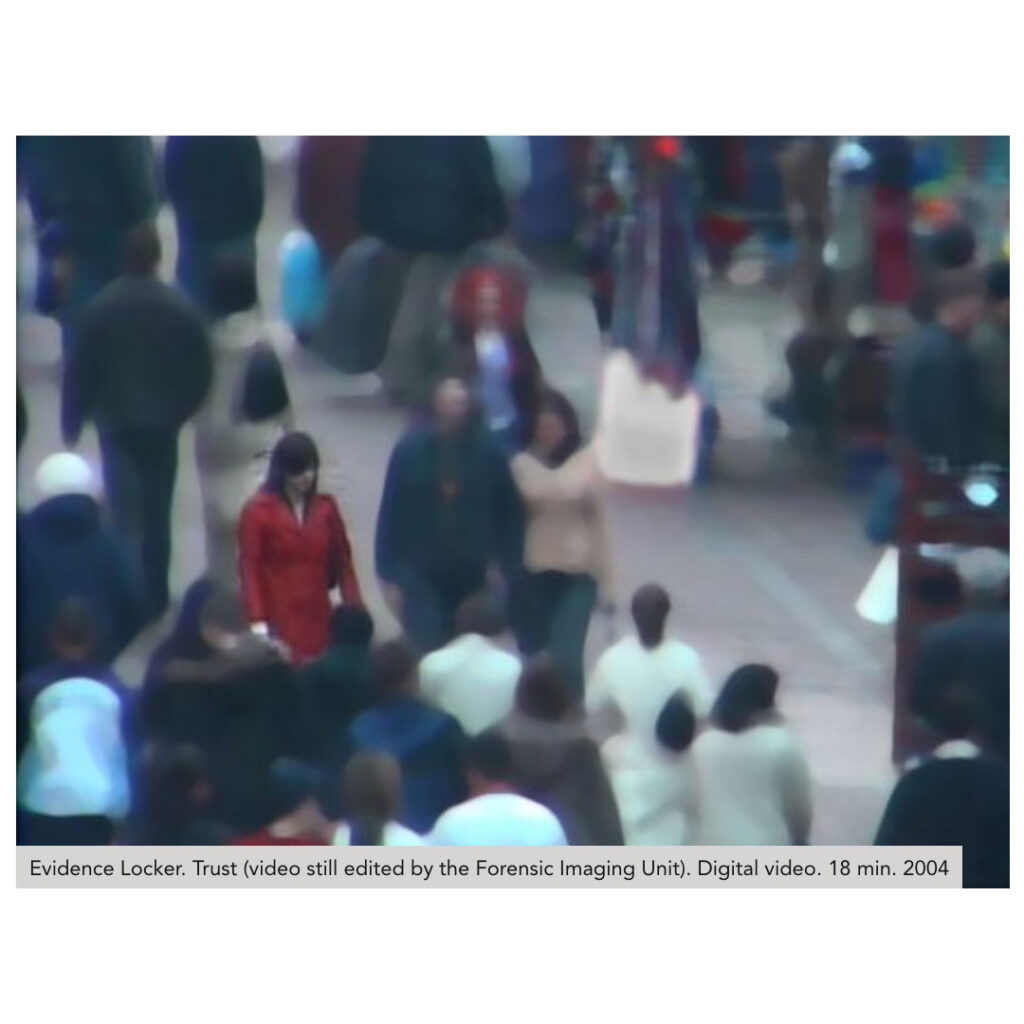
Evidence Locker (Jill Magid, 2004)
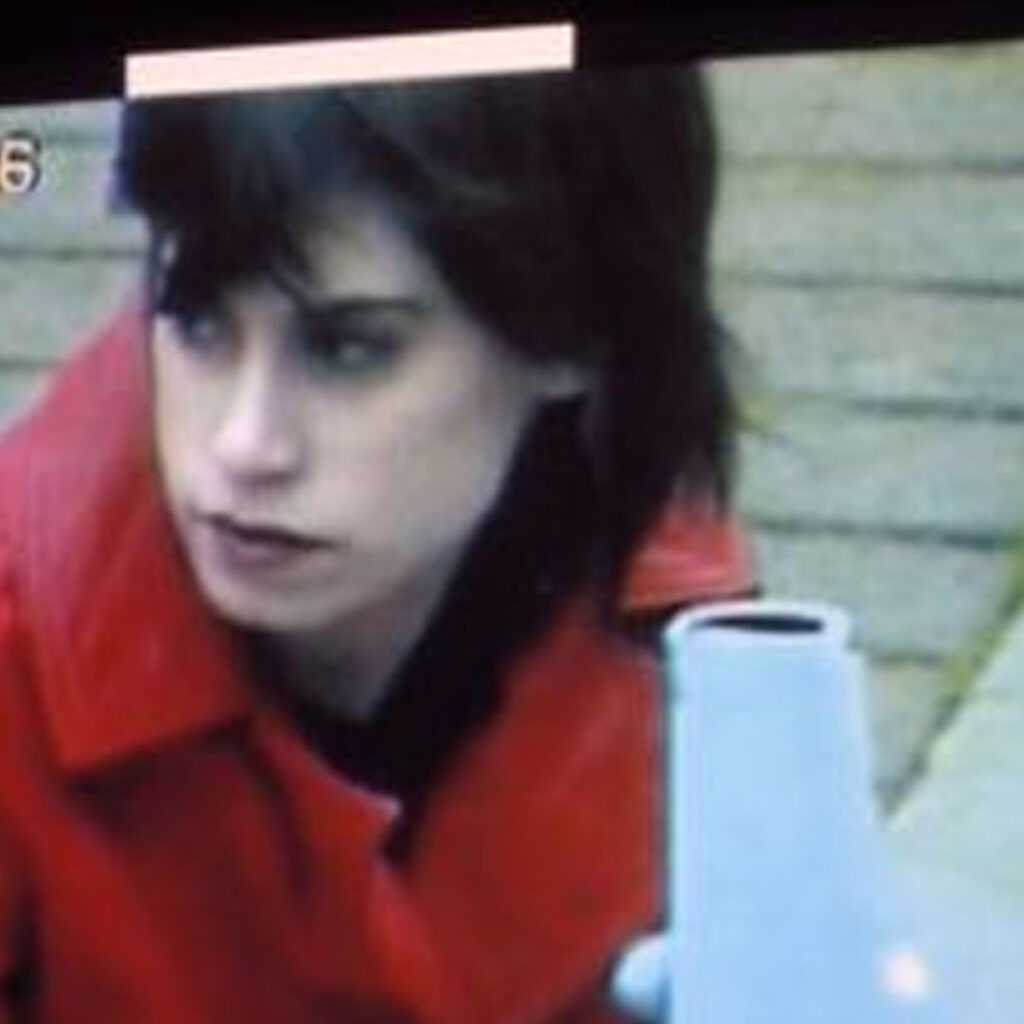
In Evidence Locker (2004), artist Jill Magid spent 31 days in Liverpool engaging with the city’s vast CCTV network operated by Citywatch. Wearing a red trench coat, she staged performances in public spaces and directed police to film her using surveillance cameras.
Unless requested as evidence, CCTV footage obtained from the system is stored for 31 days before being erased. Magid submitted 31 Subject Access Request Forms—legal documents detailing the time and nature of each ‘incident.’ She wrote them as intimate letters to a lover, sharing her thoughts and feelings. These letters became One Cycle of Memory in the City of L, a poetic diary capturing her relationship with surveillance, imagery and the city.
Unlike Magid, the Buddha hasn’t requested yet CCTV footage from Tate’s security to write poems about it. Magid faced security cameras essentially for herself. The Buddha is there strictly for us, it wouldn’t be there if it wasn’t first an image in his creator’s head, which probably came to him from the combination of other images he had registered in his brain before, like of Buddhist temples in Korea, of vitrines showcasing lastest-generation televisions, cyberworlds from science fiction novels or media theory books, like Mcluhan’s Understanding Media: The Extensions of Man, whose groundbreaking ideas about how media systems shape how we think and perceive the world are contemporary to Paik’s sculptures. “The medium is the message” is somewhat an eerie proposition by itself; if Mcluhan compared media to extra human limbs, they sometimes do feel more like whole, independent living beings.
If an observer stands behind the Buddha, they will also see themselves in its screen. Many people, when realizing this interactive aspect of the piece, can’t help but to draw out their phones and make a recording of a recording. And, as the two cameras collide – Buddha’s and the Observer’s – they may form an infinite loop of images. This new imagistic space will resemble a room inside a room inside a room and so on, forever. One can’t help but to fail miserably trying to picture how many ghosts live inside this one loop. But it’s safe to say is this much: there are many more haunted rooms in our haunted manor than we first imagined.
Main Sources and Further Exploration:
“Do Big Cats Love Calvin Klein Cologne?” by National Geographic. YouTube, June 28, 2010.
Evidence Locker, by Jill Magid, 2004.
TV Buddha, by Nam June Paik, 1974.
Pictures of Ghosts, directed by Kleber Mendonça Filho, 2023.
“Camera Lucida,” by Sarah Charlesworth. Artforum.
Related Books:
Camera Lucida: Reflections on Photography, by Roland Barthes. Translated by Richard Howard. Hill and Wang, 2010. Buy on Bookshop.org*
Understanding Media: The Extensions of Man, by Marshall McLuhan. Introduction by Lewis H. Lapham. MIT Press, 1994. Buy on Bookshop.org*
“Time and J. W. Dunne,” by Jorge Luis Borges. In Other Inquisitions, 1937–1952. Translated by Ruth L. C. Simms. University of Texas Press, 1964. Buy on Bookshop.org*
*Bookshop.org does not sponsor us, but purchases from affiliated links support our work (at no additional cost to you) Also, every purchase on Bookshop.org financially supports independent bookstores instead of billion-dollar companies. Learn more