

In the piece “Messi es un perro”, Argentinian journalist and longtime Barcelona resident Hernán Casciari compares Lionel Messi to a dog. However, his goal is not to insult or ridicule the player. Casciari presents one of the most beautiful sports chronicles of this century. Written in 2012, this type of chronicle is a dying breed today: literary sports writing.

Casciari suggests that Messi is driven by a simple, dog-like fascination with something. In Messi’s case, as with many dogs, it is to move a ball to a specific place without concern for the complexities of the human world. A dog sees something about “ball”, “bone”, or “stick”, not because they are a ball, a bone, or a stick, but because they are simply there. It’s an instinct fascination, beyond meaning. For the dog, for a moment, that object is the center of the world. Dogs are willing to put themselves in danger just to get it. Maybe what comes closest to this experience for human beings is their devotion to God. Or the game of football.
Imagine that a human being has the power to look at something like a dog does. Beyond language. It is a truly beautiful idea. A romantic and colorful literary work about modern football. We don’t get many of those anymore.
A neurolinguistic twist in (sports) reality
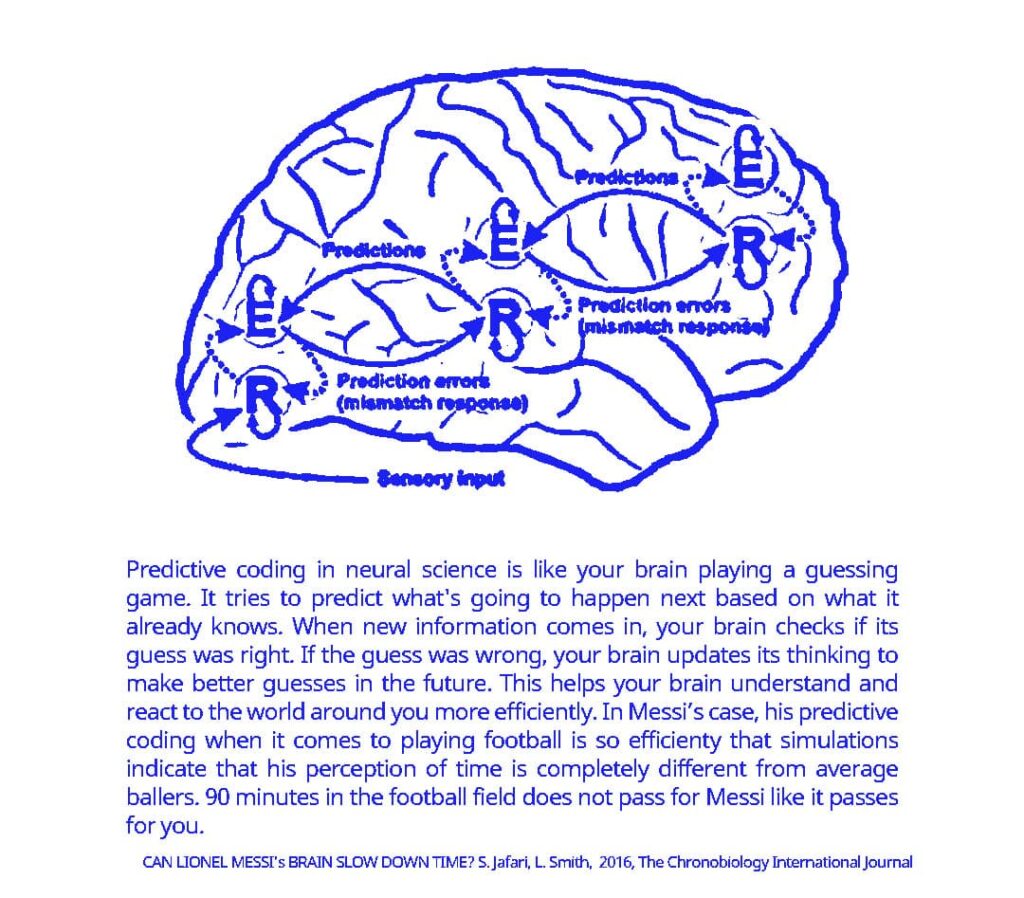
If literature says that Messi is not bound by language, some scientist say what could explain his superiority in football is exactly language. Not English or Spanish, but the language systems our human brain is coded with. From the field of neural science and computational simulation came the theory that Lionel Messi can slow down time. You read that right. Slow down time.
Messi’s innate football talents hint at a distinct perception of time, possibly influencing his life on and off the field. Two scientific papers investigate this with solid neuroscience methodologies, examining neural dynamics and predictive coding.
This hypothesis is examined in scientific papers, notably by Jafari & Smith (2016) and discussed in the context of Erren et al. (2016), through a lens of advanced neurocognitive processing and neural efficiency. The technical underpinnings involve differential equations modeling neuronal dynamics, the optimization of neural network structures for predictive coding, and the role of focused attention states in modulating time perception. These mechanisms suggest that through rigorous training and possibly genetic factors, elite athletes achieve a level of brain function optimization that allows them to process and respond to external stimuli with exceptional speed, giving the subjective experience of extended time during critical moments of performance.
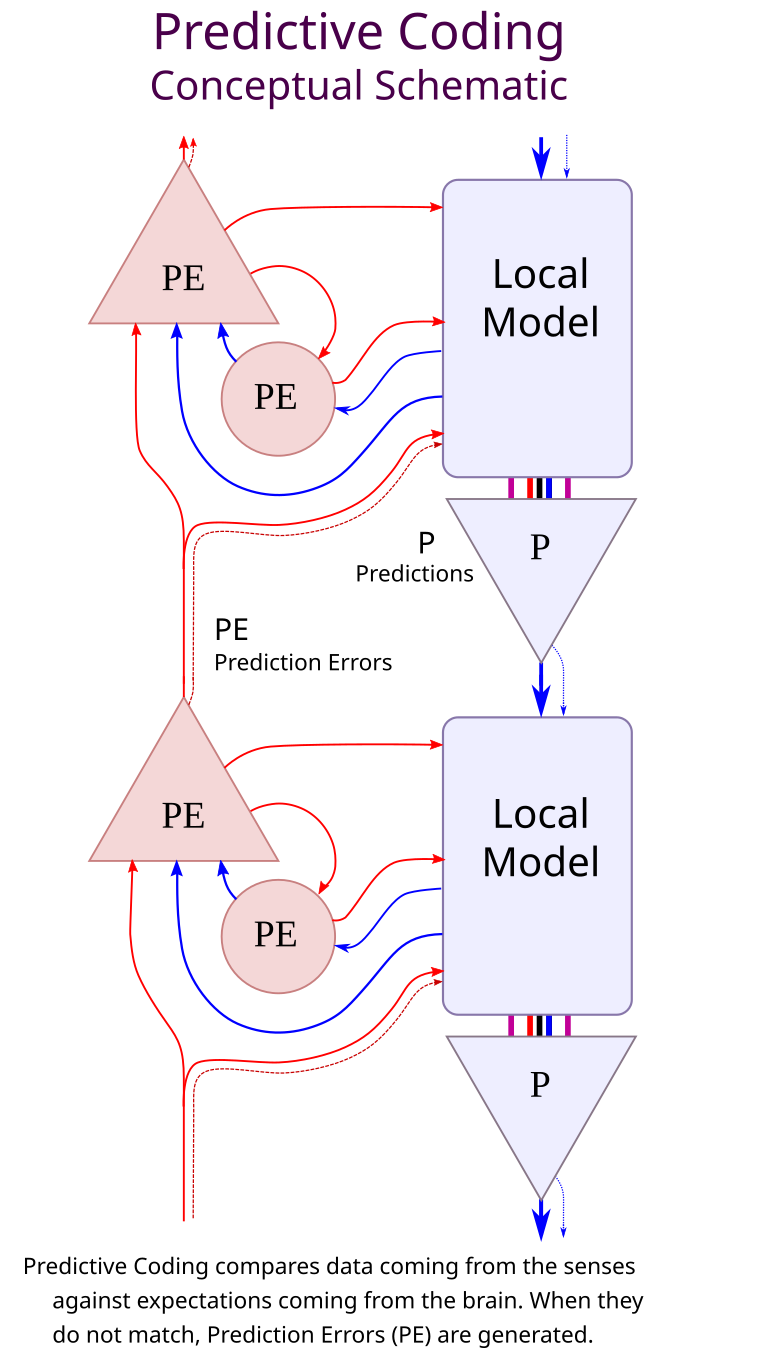
Predictive coding, essentially a biological semantic algorithm, anticipates future occurrences. While some might see it as just having quick reflexes, Messi’s ability to foresee game plays indicates he has an extraordinary perception of the world, vastly different from the average individual.
While some may dismiss things like football fanaticism, dog-men, and the slowing of time as stupid and meaningless, it is in such mental spaces that language, whether through words, synapses, or code, often takes its most free, creative, and promising forms.
The silly, beautiful thing that matters the most
Language, the fuel of creation, can then blossom into many incredible discoveries, such as scientific innovation, social ideas and the most important of all: football. Or other silly, beautiful things that warm your soul.