
There is a scene in the film Bruce Almighty that reminds me of the Louvre Museum. Jim Carrey, now as God, starts to listen to everyone who is currently praying, all at once, inside his head. This is what being inside of Louvre feels like. An endless city of stairs and corridors; full of strange voices, faces and bodies, human and beyond; from babies couple of months old to 10.000 years old glaring statues. It is very easy to feel overwhelmed. If you are expecting to see everything in one day, you better dust off your running shoes: you will have to go through almost 15 kilometres worth of corridors, stairs and galleries. If you look at each piece for 30 seconds, it would take you 100 days to see it all. Maybe you should skip the trip altogether, limit the artistic dosage to a nice French bottle label; and enjoy instead the familiar insides of a wine in the comfort of your home.
There is a scene in the film Bruce Almighty that reminds me of the Louvre Museum. Jim Carrey, playing God, can suddenly hear everyone who is praying inside his head. That is what the Louvre sounds like. It is an endless labyrinth of stairs and corridors, full of strange voices, faces and bodies — both human and otherworldly — ranging from babies a couple of months old to glaring statues that are 10,000 years old. It’s easy to feel overwhelmed. If you’re planning to see everything in one day, you’d better dust off your running shoes — you’ll have to cover almost 15 kilometres. If you spend 30 seconds looking at each piece, it would take you 100 days to see it all. Perhaps you should skip the trip altogether and enjoy the familiar insides of a French wine bottle with a nice label in the comfort of your own home instead.
Even if your are two bottles deep, and your house is no closer than 10 thousand kilometers from Paris you most definitively know where almost all Louvre visitors are headed to: Mona Lisa. Yet, can you guess what the other most visited places in the Louvre are? Mona Lisa is actually number two. The most visited place in the Louvre is its entrance: the Pyramid, by legendary Chinese architect I.M Pei; basically because you don’t need a ticket to see it. At third place is Venus de Milo by Alexandros of Antioch, one of the most known artworks in the world. Then there is the Winged Victory of Samothrace, which was carved around 190 BCE by an unknown artist. You probably never heard of it, but visitors spend more time looking at this sculpture than they do at the Mona Lisa, not because it is particularly famous, but because it is located at the top of a staircase where people usually go to sit and rest. At fifth place is the floor-to-ceiling painting The Wedding Feast of Cana by Veronese. Also an accidental visit, because it is in the same room of Mona Lisa, opposite to it.
Then we have this.
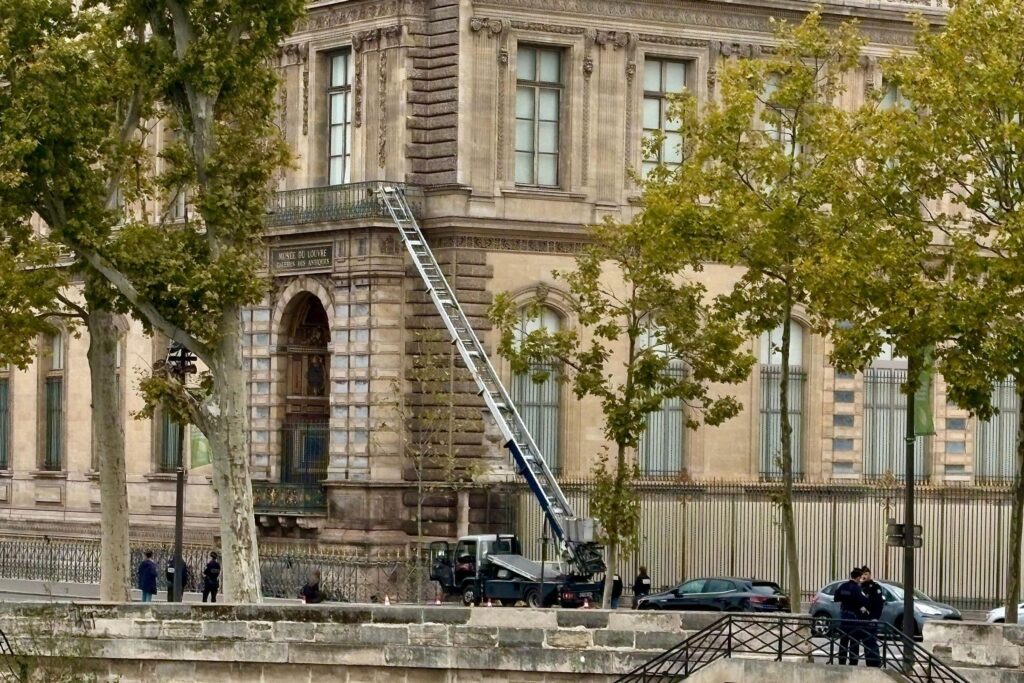
This balcony has been one of the most visited and photographed places in all Louvre in 2025.It was from here that the infamous Louvre Heist took place. The thieves used a furniture lift to break in and steal 102 million dollars worth of french imperial jewellery. Then fled in electric scooters. The whole thing lasted about 7 minutes. It was October 19, 2025. A busy Parisian Sunday. The heist seemed something out of a Tom Cruise movie – even the suspects in custody look like movie stars – it made a simple balcony become one of the most popular destinations in all Paris, and it is still unsolved to this date. The aftermath revealed how unbelievably poor security there was in the less visited part of the museum, which keeps an immeasurable amount of wealth in artworks and historic artefacts.
Even considering all these facts this was hardly the most notorious robbery that took place in the Louvre Museum. In 1911, Mona Lisa mysteriously vanished from its gallery in Louvre. Pablo Picasso was then brought in by the police as a suspect for stealing it.
All began when Ga’ry Pieret – a youthful secretary to poet-critic Guilaume Appolinaire – asked Picasso if he wanted anything from the Louvre. Pieret told him how easy it was to steal from the under visited parts of the museum. Probably out of a request from Picasso, Pieret brought the artist two ancient Iberian stone heads, that stayed with Picasso for quite a while. The sculptures influenced him deeply, Picasso used them as reference for the nudes in Les Demoiselles D’Avignon, arguably his most famous work and the boldest attack on classical European art the world has yet seen – at least according to Yve-Alain Bois.
When Mona Lisa disappearance made headlines, Pieret wanted to surf the hype and came to the press to brag about how easy was to steal from Louvre’s collection, confessing his deeds with Picasso and Apollinaire. Worried about the repercussions, both poet and artist came forward and returned the stolen stone heads. The news made headlines throughout France and abroad, highlighting Picasso’s involvement. The Paris police were equally interested, and brought both artists in for questioning on the matter, concerned that they had played a part in the robbery of Da Vinci’s masterpiece.
In fact, none of them, including Pieret, had anything to do with the Mona Lisa heist. The culprit ended up being a former Italian employee by the name of Vincenzo Peruggia. On a Monday, when the museum was closed for the public, he dressed for the last time as a Louvre worker, took the painting out of its place in Salon Carré, put it under his coat and calmly walked way. Back then there were no alarms or guards. However, at the exit, he just couldn’t make the doors open. Another employee came to see what was happening; only to cluelessly help the thief leave the museum with its most prized artwork under the armpit.
And during two years, Mona Lisa sat quietly in Vincenzo’s small parisian apartment. Imagine having the most famous artwork in the world sitting in your bedroom for almost two years, Mona Lisa’s gaze and smile scanning through your pile of dirty clothes.Vincenzo said later that he believed the painting was stolen from Italy, and wanted to return it to his country – eye for an eye. I don’t know if his true intentions were as patriotic, but in 1913 he contacted an Venetian art dealer, trying to sell the painting to an Italian museum. The dealer immediately alerted the authorities, and Vincenzo was finally arrested.
He spent 7 months in a French jail. Back in Italy, some viewed him as a misguided art robinhood. And although a few years later no one would remember Vincenzo’s name, his deed would impact the art world forever. The robbery changed Monalisa deeply. Before, it was an important work: it was painted by genius, the lady portraited was enigmatic, it was a brilliant display of classical techniques, sure, but its narrative for the public was cold, distant, idle. After the theft, the artwork was catapulted to unprecedented fame, its subtle smile became a scream, or better: a talkative mouth in a lively dialogue with the public.
The buzz about the crime embedded the painting with a new story, one that was loaded with very popular genres: crime, mystery and even an international beef. The appeal of this new twist also increased the interest to the painting’s other qualities and historical facts.Vincenzo’s robbery was like adding a Sharpie-drawn wink to the Mona Lisa. Suddenly, there was an extra layer to its meaning and appeal. Except that the Sharpie’s ink was invisible: a silent vandalisation that left no marks.
When people say art is never finished, they usually mean that there is always an extra possibility to its making: an additional hue of blue here, a better word there, a different camera angle. However, at some point, the artist has to stop. But art is also unfinished in another sense: no matter what, it will keep changing long after its maker is done with it. No matter have subtle it is – the piece keeps changing like a living organism. It is like a work of art lives forever dancing with time and space; and, like a dancer that uses the next second to slightly alter their pose, so in a matter of minutes their performance can convey a completely different emotion, an artwork exchange dialogues with environmental forces to change what it has to say.
Every time an artwork is moved from a location to another, every time that it is presented in a different exhibition, paired with different works, or being endless remixed and reproduced, something changes. And being robbed is no different.
The thief is a potent igniter of meaning. He is responsible for agitating the linguistic surface of the painting, creating new knowledge about it, creating a dialogue that is very appealing to the public: a dialogue of violence.
Alfred Hitchcock was obsessed with crime stories because he considered them the ultimate instrument for playing with human emotions. Crime narratives are very engaging, from them we are able to experience the thrills of violence without the consequences. Violence calls from emotion, empathy and attention. A person becomes more relatable in our eyes when it becomes a victim. And an artwork is no different.
But not all crimes are equally influential. Other fact that make the conversation about thefts like the Louvre heist and Mona Lisa’s so powerful is that they were not immediately solved. The absence of knowing for sure. The absence of seeing completely lies on the essence of a exciting story. If Hitchcock was obsessed with crime as a subject, he was the master of suspense as a structure. A powerful framework that feeds of immateriality: what is not there. The story is just as good as the thief.
What image is more powerful? That of an explosion. Or of a boy holding a suitcase. And what if I said that inside that boy’s suitcase, maybe, just maybe, there is a bomb, would it change your answer?
Again, we return to the effects of the “invisible Sharpie wink”. Nothing has happened, you don’t see the bomb. You don’t know if it is going to go off. But the anticipation of that “boom” cannot get out of your head. The balcony is empty. Nothing is happening there. But you cannot help but imagine the entire heist in your head. It is like the balcony, the suitcase, Mona Lisa’s empty room is saying something to you. Hey, a robbery happened here, will maybe the thieves return for more? Hey, I am going to explode soon… Or maybe not.
The boy with a bomb scenario was used by Hitchcock himself. The scene is in his 1936 movie Sabotage. And the director uses it to explain the essence of his storytelling in his interviews with François Truffaut.
Would Mona Lisa be the phenomenon that is today if Vincenzo hadn’t add his twist to its history? And would it be so famous if Vincenzo wasn’t able to leave the museum and was caught immediately, removing all the suspense from the crime and the paintings whereabouts?
Although robberies have always played a significant role in art, they have largely been overlooked as a subject of analysis throughout most of its history.
We have to thank thinkers and artists that opened our eyes to the impact of the effects of art beyond its internal systems of colour, contrast, representation, materiality and so on. And that art is also an unstable, living dialogue with the people and places that surround it. Funny enough, to get to this realisation, more crimes were committed as part of the process. Specially the burning of vehicles – but “for a better end”, “Vincenzo” way.
In the protests of May 1968, colliding with an ever-growing authoritarian reality, students came to realise that production of knowledge was not a neutral force. It was governed by relations of power and context. In the realm of philosophy and linguistics, authors like Michel Foucault and Émile Benveniste articulated ideas on how language is influenced by these relations. When people talk, there are always shifting parts that do not depend of what is being said, but how, where and by whom is being said: not only the form and content convey meaning, but also the discourse.
In the visual arts, artists started experimenting with the influence of these changing forces on an artwork.
In 1973, the French artist Daniel Buren presented a work which consisted of unframed, suspended canvases; they were set up in a line that started inside of the an art gallery in New York City, but extended far off of it. The paintings continued out of the window, crossing the street and finally ending tied to the building across the street.
The pieces that hanged above the jammed traffic and the ones that hanged before the white gallery walls were basically the same: hand painted with a basic pattern of grey-and-white stripes. But they sparked different ideas. Depending of their place, they appeared to be a minimalistic, color field style painting, like Mark Rothko’s and Barnett Newman’s, or just sheets hung to dry.
The art gallery is designed to convey uniqueness, authenticity and scarceness, so that art is able to live in a parallel dimension from everyday things. But what happens to an artwork when it leaves the frame of the gallery, and people see first a flag, an ad or a towel awaiting to dry? Did Mona Lisa stopped being a masterpiece when it stood amidst Vincenzo’s socks and pillows? Would a clueless friend see to it more than an old-fashioned piece of decoration Vicenzo brought in to make his flat look nicier?
If Daniel Burens canvases were stolen, would the ones inside the gallery be worth more than the ones hanging above the streets?
Burens shows us how art absorbs meaning from the context and relations of power (in this case, the authority of the gallery). Another famous anecdote in the world of art that exemplifies this is when an accidental object inside of a museum or gallery is mistaken with a work of art: like a soda can or shoe lace.
The gallery and the gallerist, from their place of authority, produce knowledge about the piece: it is art; it is conceptual; it is valuable; it is unique. In a similar way, the burglar does the same, from a place of forceful power, and which the media perpetuates even further: this very valuable historical object was robbed without much trouble, Louvre is incompetent, Picasso was one of the suspects, it stayed “lost” for 2 years, where was it? And so on.
This way of analyzing art can – somewhat, this is by no means an academical essay on art criticism – be called post-structuralism. Which mean recognizing that art lives in a system of its own (structuralism) and than understanding that it is not a closed system, it exists in a complex and unstable context of forces.
And if the discussion about the relevancy of art theft was dormant before, right now, it seems to be in an all-time high. Besides the cinematic Louvre heist, there was a more recent one that happened in Sao Paulo, Brazil, where a bunch of Matisse and Portinari gravures were stolen in plain daylight without much effort – maybe they where inspired by their Parisian counterparts.
Also recently, the Louvre has created a new executive position: Art Theft Specialist; however, the job has little to do with the recent heist. It is not about pursuing glamorous security solutions like Mission: Impossible–like lasers or replacing gallery sitters with an army of black-belt soldiers. The new official position of the museum puts art theft in a different perspective, one that you probably thought about when hearing the words stealing and art beside each other: colonialism.
“They stole from Louvre? Well, the place is full of stolen stuff to begin with.” And that is completely true.
The Louvre’s foundation is rooted in ideals about art that aged very badly. The idea was to bring – that is, steal – art from all over the world so it can be displayed where, in their minds, it would be rightfully appreciated: Europe, and Paris as the universal capital of art and culture.
The art theft specialist Bénédicte Savoy’s jobs is precisely to deal with this absurd idea of universal, encyclopedic art that crossed many decades. How should European museums deal with years of pillage of culturally relevant objects in other countries? Recently, Savoy was involved in the return of twenty six artifacts to the West African country of Benin, which is documented in the 2025 film Dahomey by Mati Diop, a French director casting light on the new narratives of identity in the French-spoken world.
At one point, the film features an open talk in Benin about the return of such artefacts. The citizens opinions were diverse: some say that twenty six pieces is not nearly enough, considering that the French government possesses thousands of them that should be returned to the country, and this seems more about France trying to dignify itself than to actually make a change. Others argue that at least it is a beginning, and the return of such historical objects have immeasurable value to the locals.
Only time will tell if this is just for show or if European countries are actually serious about art renstituition. One thing that nothing can change, is the impact of theft in any stolen object. They are returned. Which loads them with a completely different meaning than if they had never left their birthplace to begin with.
A young artist in 15th-century Italy was struggling to find his style and his path to success. In need of money, he created a statue in the style of the Roman Imperial era, which was popular with wealthy collectors. He chipped and dented the marble, used an acid solution to corrode its surface; buried and unburied it so that it would look like a recently discovered masterpiece from the Roman period, over a thousand years old. He sold it as a genuine artefact to a cardinal, who eventually discovered that he had been scammed. Rather than condemning the young artist, however, the cardinal was impressed by his ability to copy the old masters and invited him to be his protégé in Rome. The cardinal was an important figure in the Church, and under his tutelage, the young artist thrived. He soon received commissions to produce the works that would carve his name forever into the history of art: The Pietà and David.
Now, that artist, Michelangelo, has a Louvre gallery named after him. To get there from the main entrance, it would take you a lot longer than the thieves took to steal the imperial jewellery from the most famous balcony in France. In the gallery, you can see sculptures and drawings by the Italian master. What you are not going to find there is the Madonna of Bruges, a famous work of Michelangelo that was stolen by the French during the Revolution Wars. It sat in Louvre for 20 years, or should I say Musée Napoleon, which was its official name during the Napoleon regime. The statue was returned after the fall of Napoleon, but there are more than a few Michelangelo’s sketches that remain there that were looted – stolen – by the Napoleonic “art scouts” in army campaigns in Florence, Rome and Venice. Napoleon was a big fan of Italian art, it seems, because he also ordered Mona Lisa to be taken down from its place in the Louvre; then he put it in his bedroom. Just like Vincenzo did.
Perhaps, when it comes to art, the thief is second only to the artist, that is, when they are not the same person.
Main Sources and Further Exploration
Dahomey, directed by Mati Diop, 2024.
“Daniel Buren Exhibition.” Daniel Buren.
The Philosophical Brothel, by Leo Steinberg. University of Chicago Press, 2001.
“Mona Lisa Theft: How the World’s Most Famous Painting Was Stolen.” The Guardian, August 5, 2011.
“Matisse Art Works Stolen from São Paulo Museum.” CBS News.
“The Burgled Louvre’s Stolen Art Expert.” The New Yorker.
“Mona Lisa Theft: Picasso, Apollinaire and Gery Pieret.” Montmartre Footsteps.
“Poststructuralism and Deconstruction.” Redalyc.
“With the stylistic inconsistencies and primitivist impulses of Les Demoiselles d’Avignon, Pablo Picasso launches the most formidable attack ever on mimetic representation,” by Yve-Alain Bois. In Art Since 1900: 1900 to 1944. Thames & Hudson, 2016.
“Poststructuralism and Deconstruction,” by Rosalind Krauss. In Art Since 1900: 1900 to 1944. Thames & Hudson, 2016.
“Pablo Picasso returns his ‘borrowed’ Iberian stone heads to the Louvre Museum in Paris from which they had been stolen: he transforms his primitivist style and with Georges Braque begins to develop Analytical Cubism,” by Rosalind Krauss. In Art Since 1900: 1900 to 1944. Thames & Hudson, 2016.
Related Books
Art Since 1900: 1900 to 1944, by Yve-Alain Bois, Benjamin H. D. Buchloh, Hal Foster, and Rosalind Krauss. Thames & Hudson, 2016. Buy on Bookshop.org
Art Since 1900: 1945 to the Present, by Hal Foster, Rosalind Krauss, Yve-Alain Bois, and Benjamin H. D. Buchloh. Thames & Hudson, 2016. Buy on Bookshop.org
Modern Art: Selected Essays, by Leo Steinberg. University of Chicago Press, 2007. Buy on Bookshop.org